Where Risk Persists – and Where It Is Removed
Case‑Use Environments for Waterless Vehicle Care
As waterless vehicle care becomes established across professional operations, the conversation is no longer about whether the approach works. That question has been answered.
The more important question now is where risk persists in traditional vehicle care operations – and where it is structurally removed when water is taken out of the process.
Risk in vehicle care is rarely created by cleaning itself. It is created by the operating environment in which cleaning takes place – and by the infrastructure, permissions, and downstream responsibilities that water introduces into that environment.
This article examines the real‑world operating contexts where waterless vehicle care delivers its greatest value, not as a sustainability initiative, but as a risk‑design decision.
From Design Principle to Operational Reality
In Designing Risk Out of Vehicle Care Operations, we explored how removing water from the cleaning process eliminates entire categories of environmental, compliance, and operational risk at source.
That principle only becomes meaningful when applied to real environments.
Different operating contexts create different risk profiles. What is manageable in one location becomes a constraint in another. What appears compliant on paper becomes fragile in practice when scaled across sites, regions, or jurisdictions.
Understanding where water creates friction and where its removal changes the operating equation is critical to making sound deployment decisions.
Fleet & Logistics Operations
High‑volume fleet environments operate under constant pressure.
Vehicles are revenue‑generating assets. Downtime is immediately visible. Movement off‑route or into wash facilities creates operational inefficiency, scheduling complexity, and lost availability.
Traditional rinse-based washing introduces several embedded risks in these environments:
- Dependence on fixed wash infrastructure
- Vehicle movement away from operational locations
- Rinse water capture, treatment, and discharge obligations
- Ongoing monitoring and maintenance of drainage and interceptor systems
Even well‑designed fleet facilities remain exposed to these dependencies.
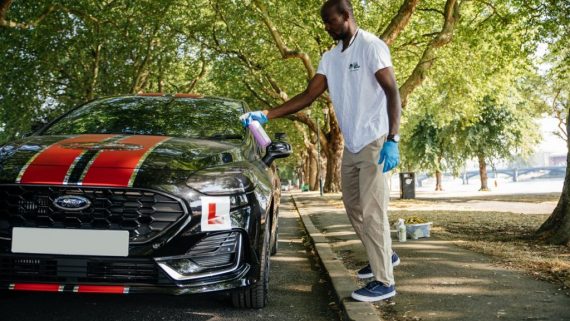
Waterless vehicle care removes these risks by decoupling cleaning from infrastructure. Vehicles can be cleaned where they are parked, when they are idle, without rinse water, runoff, or effluent.
The result is not simply faster turnaround. It is predictable availability, reduced compliance exposure, and a simplified operating model that scales across depots without site‑specific mitigation strategies.
Dealership & Forecourt Environments
Dealerships sit at the intersection of operational efficiency, brand presentation, and regulatory visibility.
Vehicles must be consistently presented to a high standard, often in constrained spaces, under public scrutiny, and within increasingly restrictive environmental conditions.
Traditional vehicle washing introduces several challenges:
- Competition for the limited wash bay space
- Vehicle shuffling and congestion
- Runoff and drainage exposure in public‑facing areas
- Heightened reputational risk if controls fail
These environments are not forgiving. Any visible compliance failure becomes a brand issue.
Waterless vehicle care fundamentally changes how risk is managed in dealership contexts. Cleaning can take place directly on the forecourt or in display areas, without hoses, drainage, or effluent.
This eliminates:
- Bay‑related bottlenecks
- Runoff exposure
- The need for visible mitigation infrastructure
For dealerships, the value lies not in speed alone, but in control – control of space, presentation, and environmental exposure.
Multi‑Site & Mobile Operations
Multi‑site operators face a different class of risk: inconsistency.
Sites vary in layout, drainage access, surface conditions, and local regulation. What is compliant in one location may be restricted or prohibited in another.
Traditional rinse‑dependent vehicle washing requires:
- Site‑by‑site assessment
- Location‑specific permissions
- Variable infrastructure investment
- Complex training and oversight
This creates uneven risk profiles across an organisation.
Waterless vehicle care simplifies this complexity by standardising the process itself. With no water requirement, no discharge points, and no effluent, the same method can be deployed across locations without redesign.
The benefit here is not convenience. It is governance consistency – the ability to apply the same controls, training, and oversight across an entire operation, regardless of site constraints.
Sensitive or Restricted Environments
Certain environments amplify risk by default.
These include:
- Airports and aviation facilities
- Ports and logistics hubs
- Urban centres
- Leasehold or temporary sites
- Locations with strict water or discharge controls
In these contexts, traditional washing often requires permits, temporary containment, or complete avoidance.
Waterless vehicle care removes the need for negotiation altogether. With no water introduced, there is no runoff to manage, no effluent to contain, and no discharge consent to obtain.
This enables vehicle care to take place within operational boundaries that would otherwise prohibit it, without creating secondary compliance obligations.
Why Environment Matters More Than Volume
A common misconception is that risk scales primarily with the number of vehicles cleaned.
In practice, risk scales with environment, not volume.
A single wash in the wrong location can create more exposure than thousands of compliant cleans in a controlled facility.
Waterless vehicle care addresses this reality by shifting risk management upstream – from treatment and mitigation to process design.
By removing water from the equation, the operating environment becomes simpler, more predictable, and easier to govern.
From Capability to Confidence
Waterless vehicle care has moved beyond novelty and into mainstream professional use.
Its value now lies in the confidence it provides:
- Confidence that risk is designed out, not managed downstream
- Confidence that operations can scale without compounding exposure
- Confidence that compliance is simplified, not multiplied
Understanding where this confidence is most valuable begins with understanding the environments in which vehicles are cleaned.
That is where the real operational advantage lies.
Pearl Quality Standards – engineered properly from the start.
British manufacturing you can trust, partnering with domestic and international customers to deliver sustainable growth and lasting success.
© Pearl Global Ltd — ISO‑Certified British Manufacturing Excellence in Processes, Systems and Product Quality Standards
All Pearl products are engineered using safe, sustainable, environmentally responsible formulations, designed for professional performance with minimal environmental impact. Manufactured exclusively in the United Kingdom and available worldwide in 25L, 205L and 1000L IBC formats, alongside a full range of premium Nano Ceramic coatings, detailing systems and specialist maintenance solutions.
For product support or commercial trade enquiries, contact: sales@pearlgloballtd.com | +44 (0)845 874 0140
Stay updated — Subscribe to the Pearl Official Newsletter for product releases, ecological insights and global business updates.
Pearl Official Channels & Resources
Pearl FAQ – Your central hub for answers to the most common questions about Pearl products, technologies, manufacturing standards and global distribution.
Pearl Official YouTube – Explore demonstrations, application tutorials, product walk‑throughs and professional detailing techniques.
Pearl Official Instagram – Discover visual highlights, partner showcases, behind‑the‑scenes content and professional detailing results.
Pearl Official Facebook – Follow us for updates, product insights, partner news and global waterless car care innovations.
Pearl Official X – Stay informed with quick updates, industry news, technical insights and global announcements.